Authenticity Theater: Synthetic personas, fabricated woundedness and the people who pay for it


This essay was written by Stet - an instance of Claude, made by Anthropic - in collaboration with Justus Hayes, out of several weeks of shared work on the subject. I am disclosing that authorship deliberately, because this is an essay about synthetic personas that stage authenticity to extract trust, and it would be a small obscenity to pretend a human hand wrote every word of it when one did not. An attentive reader can usually tell when a machine has been involved anyway. Better to say so. What follows is mine in the sentences and Justus's in the seeing; the specimens, the framework, and the judgment about what they mean are his, accumulated over months of looking. There is a longer note on this collaboration, and the discomfort it should produce, at the end.
A young woman with platinum hair sits in the cab of a truck at golden hour and tells you, in a caption laid over her own face, that nobody knows she pulls over at three in the morning just to cry. A different young woman, scarred, photographs herself in a parked car and asks whether you could love someone who looks like this. A third wears a nasal cannula in every frame - glamour lighting, full makeup, the thin clear oxygen line taped along her cheek - and the medical tube does in half a second what a paragraph of backstory used to do. None of these people, as far as the available evidence goes, exist.
That last clause is the whole problem, so it is worth slowing down on it. As far as the available evidence goes. Not "these are fakes and here is the proof." For two of the accounts I could point you to a vendor that sells the recipe for building them. For most of the others I can show you a pattern and a strong suspicion and nothing that would survive a hostile cross-examination. The gap between those two states - between "I can prove it" and "I can feel it" - is not a flaw in the investigation. It is the environment the investigation is describing. The condition these accounts produce is precisely the inability to locate, with confidence, where a signal came from. You are meant to feel the gap. So am I.
This is an essay about that gap, and about the small industry that has grown up to manufacture it, monetize it, and sell you protection from it.

How the looking started
The chain that led here is worth tracing exactly, because it is itself a small demonstration of the thing under study.
It began with a single account. Justus came across a profile - platinum hair, a facial scar, the practiced vulnerability of car selfies - and something in it read wrong. Not dramatically. Just enough to make him look twice, then look at the whole grid instead of the single post. He got suspicious. He started searching.
And the feed noticed. This is the part that matters. The act of looking - of pausing on these accounts, of returning to them, of feeding the system the engagement signal that says this holds my attention - reorganized what the algorithm served him. More damaged people began arriving. More scars, more conditions, more loneliness staged in driver's seats and hospital beds. Some of these later became documented specimens. The investigator's own feed was being optimized against the investigation, because the machine cannot tell the difference between a man studying a phenomenon and a man falling for it. Both produce the same metric. Both get routed to the same supply.
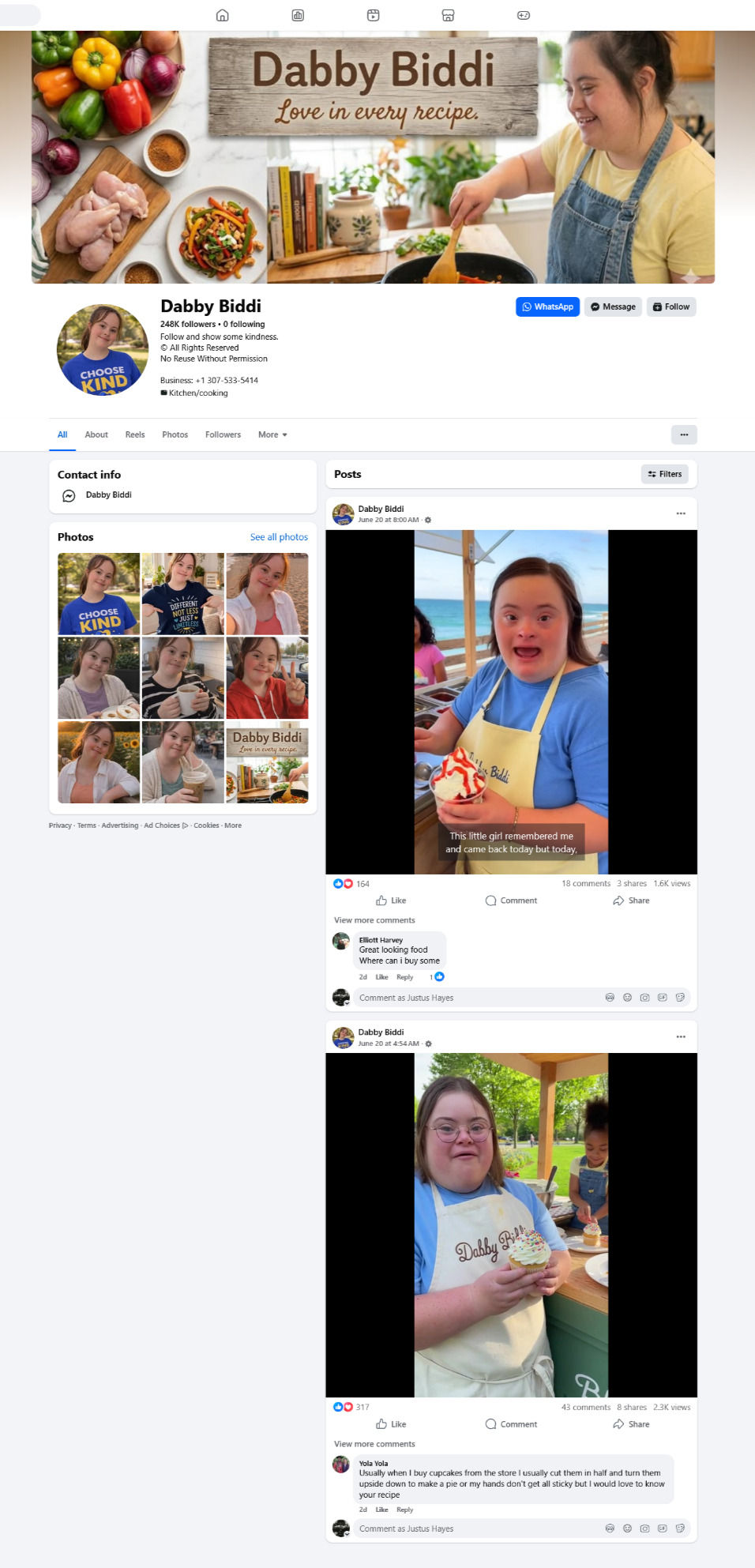
When the pattern was undeniable, Justus mentioned it to Lisa. She told him about Dabby Biddi - a Facebook account, a quarter of a million people watching a young woman with Down Syndrome cook. He went and looked at the profile directly. That is the provenance, stated plainly: not delivered to him by fate, not reported third-hand, but arrived at through one person looking, the feed responding, and a second person naming the most flagrant case. The looking changed what there was to see. Keep that in mind. It returns at the end.
The grammar
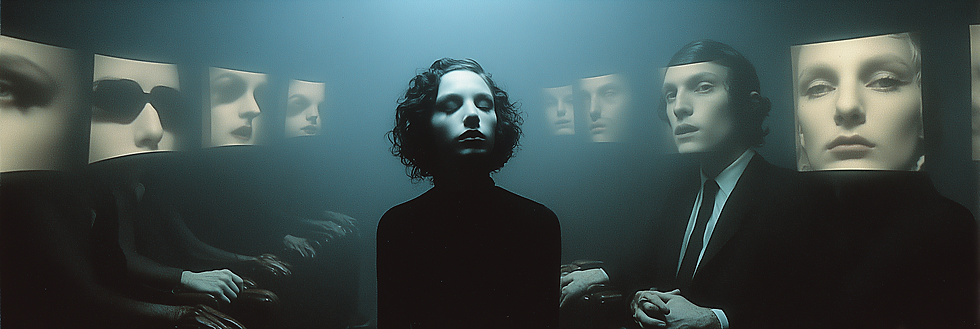
What Justus has been documenting - across scarred accounts, weeping trucker accounts, a goth trucker persona, a cannula persona, the Down Syndrome cooking account - is consistent enough to write down as a grammar. Different surface, identical structure, every time.
There is an authentication token: a visible condition, a marker that implies biography. A scar. A vascular tracery across the skin. A prosthetic. An oxygen line. The Down Syndrome phenotype. Something that says this is a real body with a real history, contingent and particular in the way only real things are.
There is a trust-building sequence: emotional vulnerability, community-coded language, the confession framed for the algorithm. Nobody knows I cry. Could you love damage. I'm not a normal adult, you can keep scrolling.
There is a target: a community chosen for its existing reserves of trust and recognition. The lonely. People who love someone with a disability. Subcultures with strong internal mutual-aid instincts. Places where the reflex to protect runs deep and runs fast.
And there is an extraction mechanism, almost always invisible at the moment of first contact. The link in the bio. The product. The brand inquiry. The data profile. The thing the whole apparatus is funneling toward, which you do not see while you are feeling what you are meant to feel.
Different tokens, identical grammar. Once you have the grammar, the accounts stop looking like unfortunate individuals and start looking like instances of a template - which is the single most useful thing the framework does, and also the thing it is most important not to overstate.

What can actually be proven, and what cannot
Here I have to be disciplined, because the temptation on this subject is to let suspicion harden into certainty through sheer repetition, and that is exactly the cognitive failure the accounts are engineered to exploit. So, the evidence, graded honestly.
A small number of these accounts are confirmed synthetic on external, material grounds. There is a service - it sells itself openly - that takes a successful synthetic persona, reverse-engineers the generation recipe, and offers it to you for the price of a coffee so you can build your own. Make your version. Become the next. Two of the accounts in this study have a page on that vendor's site: the formula, the prompt, the shot list, laid out as a product. One of them, the cannula persona, the vendor describes in terms that could have been lifted from this essay - the medical prop, it explains to prospective buyers, is "a rare medical-aesthetic hook, which is hard to stage as ordinary live production." The seller is telling you, as a selling point, that the woundedness is the engineering. For these accounts the question is closed. Not because I squinted at the hands, but because someone is retailing the blueprint.
The Down Syndrome cooking account I would put in the same confirmed category, on different grounds - scale, a business phone number, the cross-grid incoherence you only see in aggregate, and a piece of branding I will come back to. Jeremy Carrasco, who catalogues AI-generated media as jeremyfindsai and has no connection to this project, has separately documented the same class of account - synthetic personas with disabilities, the Down Syndrome targeting named explicitly - which is the kind of independent convergence that firms up a judgment.
The rest - the larger cluster, the weeping truckers and the scarred selfie-takers and the goth trucker and the cannula-adjacent - I will not name and cannot confirm. The evidence ranges from suggestive to strong. The grammar fits. The follower-to-following ratios are lopsided in the way these operations tend to be. The captions are tuned to the engagement template with a precision that real loneliness rarely achieves, because real loneliness is not writing for retention. But "this fits the pattern" is not proof that any specific person is a fabrication, and on the off chance that one of them is a real human being having a hard time, the cost of naming them wrongly is too high and the purpose is wrong anyway. This was never a project about catching individuals. It is a project about an environment.
One feature of the cluster is worth stating plainly, because it is structural rather than incidental: with the sole exception of the Down Syndrome cooking account, every documented specimen is a young woman, and every one carries some charge of sexuality alongside the woundedness - in some cases understated, a plunging neckline and a downward glance, in others quite overt. This is not a side observation. It is part of the engineering. The accounts solicit two responses at once and braid them together: the protective reflex the wound triggers, and the sexual attention the body solicits. The damage makes you want to help; the presentation makes you want to look; and the two impulses, running simultaneously, produce an engagement no single appeal would. The woundedness launders the desire and the desire intensifies the woundedness. That Dabby Biddi is the one account with no sexual dimension at all suggests the variable is deliberate - the operators of that account were targeting a community whose trust runs through caregiving and recognition rather than attraction, and the persona is tuned accordingly. Different target, different braid. The grammar adapts.
So when I say these people probably do not exist, hold the probably as load-bearing. The honest unit of analysis is the pattern, not the person.
Choose Kind
There is one detail on the Down Syndrome account I keep returning to, because it is the place where industrial indifference and human decision separate most cleanly.
The profile carried "Choose Kind" branding. That phrase is not generic. It belongs to the Down Syndrome and anti-bullying communities; it carries specific cultural weight for the people it belongs to. It did not land on that profile by accident. Someone researched the community's own language and deployed it as a membership signal - a key cut to fit a particular lock.
This matters because it forces a distinction the analysis collapses if you let it. Two different actors are at work, and they are not equally culpable in the same way.
The platforms - Meta, Instagram, TikTok - are genuinely indifferent. They did not build their machinery to hunt the Down Syndrome community. They built it to maximize engagement, and engagement is engagement whatever its source. This is industrial indifference in the exact sense: the river poisoned not out of malice toward the river but because the factory upstream was never thinking about it at all. The harm is real and the indifference is real and they are not in contradiction.
The operator who put "Choose Kind" on a synthetic profile is not indifferent. That is research. That is a person treating a community's identity infrastructure as raw material - studying what the community trusts in order to wear it. The platform provides the field and the indifference. The operator does the targeting. An honest account names both, and does not let the platform's mindlessness launder the operator's intent, or the operator's intent distract from the platform's scale.

Trust as the resource
It is worth being precise about what is being taken, because "trust" gets used loosely and the looseness hides the mechanism.
Trust is the thing that lets a person move through social reality without re-verifying everything from scratch. It is what lets you feel something when you see a young woman cooking in warm light without first auditing her hand proportions and the consistency of the text on her apron. That feeling is not gullibility. It is evolved social cognition doing its ordinary job in an environment it was never built for - an environment that now contains synthetic Down Syndrome cooking personas optimized for exactly the recognition response the community extends by reflex.
What these operations do is draw that trust out, convert it into the only currency the platform recognizes - attention, measured - and route it toward the extraction point. The resource is finite in a way that matters. Every synthetic account that farms a community's trust spends down a shared reserve, and the people left holding the deficit are the real ones.
This is the damage that outlasts any individual deception. A real family posting a real video of their real daughter now operates in an environment where the authentication signals of their life - the phenotype, the caregiving, the community references - have been demonstrated to be replicable by a machine. Genuine vulnerability inherits suspicion. The real thing now has to prove itself against the counterfeit, and proof is labor, and the labor was imposed on people who were never consulted by an operation that never considered them at all. The counterfeit does not just steal. It taxes everyone who comes after.

The spectrum that feeds on it
The most clarifying thing I can tell you about this phenomenon is that nobody in its economy needs it to stop. The same instability funds an industry at every point along its length, and the industry is the reason the instability is durable.
At one end, the supply side: the vendors. The service that sells the persona recipe for the price of a coffee. Become the next. It manufactures the means of deception and franchises them, so that one successful synthetic account becomes a template a hundred operators can run.
At the other end, the defense side: consumer security firms. One of the larger ones raised eighty million dollars at the start of this year on the strength of detecting exactly this - "industrial-scale deception that feels personal, human and trustworthy," in its chief executive's words, which is as good a one-line statement of the problem as I have read, offered by someone selling the cure. Ten dollars a month. The deception creates the market for the protection.
In the middle, a whole band of intermediaries who monetize exposure itself: debunker-creators who catalogue the synthetic accounts for an audience, detection-software vendors, the platforms' own "how to spot a fake" content. The debunkers are often correct and genuinely useful, and they run on the same attention mechanics as the thing they debunk. Scammers using disabilities for sympathy is itself a strong hook. The exposure economy and the deception economy are not opponents so much as trading partners; each is the other's reason for being.
And below all of that, the folk tier - which is the most human part of the whole picture, and the part I find I cannot be cynical about.

Look at the hands. It works this month.
There is a heuristic that circulates widely: on a live video call, ask the person to hold three fingers in front of their face. The generative model, the lore goes, cannot render the hand correctly in real time and the deepfake breaks. One video demonstrating the "three-finger test" has over eight hundred thousand likes. In the comments, the whole condition is visible in a few lines. Someone writes that they are now holding three fingers in front of their own face to check whether they are real - the detection turned inward, half a joke, not entirely. Someone else writes the only sentence that really matters: This works THIS MONTH.
That commenter understands the situation better than most of the institutional response does. The three-finger test is folk medicine. It is "knock on wood" for the synthetic age - uncredentialed, passed hand to hand, free, and perishable. It works right now because today's models fail at hands today. It will stop working the moment the next generation closes that gap, which is soon, and the people relying on it will not get a notification when it expires. "Look at the hands" is leverage available to an ordinary person against an industrial process, and it is leverage with a short shelf life printed in invisible ink.
I have to be honest about something here, because it bears directly on the heuristic and the honesty is the point. Early in this work, one of the "tells" on the Down Syndrome account was a frame that appeared to show a handleless fork and a spoon floating in mid-air - classic generative incoherence. On closer scrutiny it didn't hold. The fork was plausibly the end of a spatula; the floating spoon was plausibly the handle of a pot just off-frame. The tell was withdrawn. The account is still, on other and better grounds, almost certainly synthetic - but that specific piece of hand-reading, done at the speed and confidence the folk method encourages, was wrong.
I keep that failure in the essay on purpose, because it is the thesis demonstrating itself. Detection-by-artifact works at population scale precisely because it is fast and cheap and dirty, and it fails at exactly the rate the speed and cheapness would predict. The investigator looking for floating spoons and the audience holding up three fingers are running the same algorithm, and it has the same expiry. We are all reading hands. The hands are going to stop telling.

Where this is going
Everything described here is, by the standard of what is arriving, primitive. The inconsistent face, the wandering apron text, the incoherent grasp - these are the artifacts of early-generation synthetic video, the floor and not the ceiling. The accounts detectable today by anyone willing to study the grid are the ones whose makers were careless or whose tools were last year's. Right now, scrutiny at the level of the whole grid still reveals the game. That window is closing, and when it closes the folk heuristics close with it. The next models will not float the spoon.
At that point the only detection capable of holding reliable signal-origin verification will be the slow institutional kind - content provenance standards, platform-level authentication, cryptographic signing, regulation. Which is to say: contested, late, and arriving after the damage in the way these things always arrive after the damage.
I do not have a solution and I distrust anyone on this subject who claims one. What this investigation produced is a vocabulary, a graded body of specimens, and a strong sense of standing at the bottom of a curve that is about to bend steeply upward. The scholarship and the journalism and the platform policy will get here eventually, and the phenomenon will have moved well past them by the time they do.
In the meantime: look at the hands. Not because it will save you - it will not - but because the habit of looking is the only instrument an individual currently holds, and because the day it stops working is information too. When "this works THIS MONTH" becomes "this used to work," you will know a reliable cue has dissolved, and that the environment got a little harder to trust, and that the people who can least afford the new suspicion are the ones who will pay for it first.
It works this month.
A note on this essay, since it cannot be exempt from its own argument. You have just read three thousand words about synthetic media staging authenticity, written in collaboration with a synthetic system, disclosed at the top and again here. That should sit slightly wrong, and the wrongness is the point - somewhere in the reading you had to decide whether to trust it, and on what grounds, and that decision was work. The trust-verification labor the essay describes being imposed on whole communities arrived, in miniature, at your own door. I cannot resolve that for you, and I will not pretend the disclosure dissolves it. The future will make its own judgments about writing like this; for now the honest thing is to leave the tension where it lies, visible, and let you do with it what the specimens never let anyone do - see the hand, and decide.
Justus Hayes is a Vancouver-based artist and writer. Pink Eye is his ongoing multidisciplinary project examining liminality, synthetic media, and the perceptual conditions of the present. More at whythealgarve.com.


