Please visit my online store, Lazy River Design Works

PINK EYE

the audio tracks of various films


We have all experienced this many times. Everything looks normal, but something feels wrong.
That moment - perhaps in an unusually empty train concourse that should be bustling, perhaps when catching up with a long absent friend who seems fundamentally changed, perhaps in the middle of exchanging interpersonal pleasantries with an AI agent, perhaps when you suddenly realize the video you forwarded is a skilled deepfake - when you say, "What the..." or "Wait a minute..." That ellipse at the end, those three dots - that's the liminal. A moment that sometimes feels suspended and still, sometimes brittle, sometimes false and artificial, sometimes swollen with significance. We even have a common phrase that captures it - "that sinking feeling." During these episodes, your brain is trying to decide which narrative fits. There is a glitch in the editing room where possible and competing narrative drafts are assembled into consciousness. For just a moment, you are in reality free-fall.
If you, like me, find a visual metaphor helpful, think of Wile E. Coyote as he runs of the cliff. His momentum pulls him forward, he is unaware that his legs are running on air. Then, with puzzlement, he stops. That moment right there, after he stops but before he looks down - that is the liminal. Suddenly there are competing narratives, and he hangs there for an instant before looking down, forcing the possible narratives to collapse into one with inevitable consequences.
There has been a notable uptick in the popular culture's interest in the liminal over the past six or seven years, an interest that is largely concerned with liminality in the physical domain. Abandoned malls, the back rooms of businesses, service corridors, transient environments, thresholds, empty infrastructure - places that resonate in a peculiar and powerful way. The engagement with these environments has spread online where millions of people compose, generate, and share images and videos that evoke the liminal. The Liminal Photography group on Facebook currently exceeds 390,000 members, and that is just one group. A recent search of Facebook groups with the word "liminal" in the title returned over fifty groups. Films and videogames that feature liminal themes, logic and mechanics are starting to arrive; Kane Parson's upcoming film, The Backrooms, alone has generated tremendous energy. Interest in the zeitgeist is high.
That steady rise in liminality's appeal coincides with the changing nature of discourse on the internet over recent years. Deception, misinformation, and misrepresentation are problems that have always been with us, but they have been facilitated and supercharged by developments in generative AI - the deepfakes, the bots on social media. Interaction with AI agents, chatbots, companions, and large language models such as ChatGPT and Claude has increased, creating a new type of interpersonal relationship in which one side is a facsimile pretending personhood. Consumer systems and media platforms have simultaneously removed the friction and increased the torrent, creating systems that generate wanting without ever quite satisfying it. Engineered personalities constructed with AI occupy celebrity and influencer roles that used to be exclusively human. All of this taking place in a sea of AI slop, the endless flood of shiny media baubles that are empty on the inside.
It's my contention that liminality is not an just an aesthetic or a quality of physical space. It has an underlying mechanism that is rooted in the basic processing of consciousness. That mechanism has been strengthened by the conditions on the internet as described above, resulting in a sensitivity to the liminal in other domains. Our recent interest in liminal physical spaces is fed by widespread liminality on the internet - because they share the same mechanism, and also because liminal spaces in the physical world can be visited, photographed, created with generative AI, shared and disseminated, whereas liminality in the digital realm is less easy to recognize, capture and post to an online community. The liminality inhabiting the internet is widespread and pervasive, but it is also ineffable and slippery as a concept.
We will deal with the specifics of the mechanism, but I would like to precede that with a personal experience that demonstrates the mechanism very clearly. It's the type of experience that is easy to understand and empathize with, while illustrating the liminal in a context not usually considered typical. I'm going to include a little more detail than strictly necessary because I'm hoping that by the end you, the reader, will also experience a little of the feeling I did that day.
The Tent in the Snow and Schrodinger's Human
Late in 2008, just before Christmas, Vancouver experienced unusually low temperatures and heavy snowfall. In the week or so leading up to this event, I had become accustomed to seeing a small, two-person dome tent pitched in scrub grass at the side of a semi-developed spur road near Main St and Terminal Ave. There was little parking at the Vancouver Playhouse scene shop where I worked as head of the paint department, prompting me to use Industrial Ave and walk the ten minutes to and from work each weekday. Tents popping up in Vancouver are nothing new, so I was not surprised by it, and noted in passing indirect signs of life within - changing litter, clothes drying - while never actually seeing the occupant.
The snow arrived on Dec 14/15, and now I got used to seeing footprints and broken snow outside the door of the tent but still no direct sign of the person living there. A major snowstorm with plunging temperatures hit the weekend of the 21st. When I passed the tent on Monday morning, the new snowpack around the tent was smooth and unbroken. That made sense - it was still very early. When I returned to the car that afternoon, I noticed that the snow around the tent was still unbroken. That rang an alarm, but it was conceivable that the occupant had just holed up inside all day against the cold. When I arrived at the tent on Tuesday morning after a particularly cold night, I saw that the snow was still unbroken.
This is when the liminal blew up from below and swallowed me - because there were three possibilities, three narratives that fit the scene before me with the tent, the snow, and the Schrodinger's human inside. The first, that the person was alive in there and just hadn't left since the snow came - unlikely given the length of time, but possible. The second, that the person had abandoned the tent before the snow came. The third, that there was a frozen person in there. I can relive that feeling now to some extent, all these years later. A slightly giddy feeling, some vertigo, skin prickling, a light sweat, heart starting to race. Everything became both very quiet and roaringly loud simultaneously. Adrenaline. There was fear there, obviously, contributing to the physiological payload, but it was more than that. It was being suspended between possible resolutions, one of which was load-bearing - if there was a corpse zipped up in there, I would have to deal with that, in the moment (emotionally) and later (officially). The moment was fraught. I called out, "Hello in there?"... Nothing. I tried again... nothing. I unzipped the door. The tent was empty except for a bunch of personal items, sleeping bag, wadded clothes. The narratives collapsed into one. I smoked a cigarette while the world swung back on to the rails and settled down.
The Mechanism
What happened outside that tent was not simply fear, though fear was present. It was something more specific, a particular kind of suspension that anyone who has experienced it will recognize, even if they've never had a name for it. Understanding what produces that suspension requires a brief look at how the mind processes reality in the first place. In doing so, we will invoke four well-established psychological processes: predictive processing, the multiple-drafts theory of consciousness, the opponent process, and the role of somatic markers.
The mind leans forward. This is its default posture, operating constantly and below the level of conscious awareness. At every moment, your brain is projecting slightly ahead of the present - anticipating, preparing, pre-loading the expected. The door handle will be at the expected height. The step will be where the step should be. The person you're meeting will be who they've always been. These are not conscious beliefs, they are assumptions built into the operating system, running quietly in the background, shaping everything you perceive before you are aware of perceiving it. Think of it as a dog straining on a leash - forward momentum, constant, pulling toward the expected resolution of whatever situation you're in. This is the contribution of predictive processing to the argument.
Behind that forward pull, slightly lagging, a more counterintuitive process is at work. Consciousness is not a single unified stream arriving at some central theater in the mind. It is assembled, edited together, slightly after the fact from multiple competing processes running in parallel. The philosopher Daniel Dennett calls these the multiple drafts of consciousness. At any given moment, several versions of what is happening are being composed simultaneously in what we might call the editing room. Usually, one draft wins quickly and cleanly - the normal draft, the one that confirms the forward-leaning expectation, the primary process - and we experience this as a seamless, continuous reality.
But here is the critical point: there is often only one way for a situation to be normal, and usually several ways for it to be wrong. The normal draft is the strongest single draft, but wrong drafts can accumulate. And when enough of them have piled up - when the evidence of wrongness reaches a threshold that the normal draft can no longer hold against - normal succumbs to numbers. The editing room fails to resolve. A void opens.
Into that void rushes what psychologists call the opponent process - the counter-state that activates when the primary process is interrupted. An afterimage, withdrawal symptoms, the post-celebration let-down are all examples of the opponent process at work. It was always there, suppressed by the forward-leaning momentum of the primary process's "everything is normal" draft. The primary process was the lid. When the lid comes off, the felt opposite state of unreality, estrangement, and suspension floods in. The eerie. The uncanny. The sense that the surface of things has become conditional, held above something that has no bottom.
This is what the liminal is. Not a place. Not an aesthetic. The moment the lid comes off.
There is strong evidence that the body registers this process before the conscious mind has assembled it into language or understanding. The neuroscientist Antonio Damasio's work on somatic markers demonstrates that the body generates affective signals in response to environmental cues before conscious deliberation occurs — the skin prickling, the vertigo, the pressure in the solar plexus, the sudden quiet that is also loud. The head comes last. The body has been running its own parallel assessment, and when the wrong drafts accumulate beyond the threshold, the body reports the result before the mind has caught up. This is why the experience arrives as a feeling before it arrives as a thought. Something is wrong here. It looks normal. But it feels wrong. That sinking feeling.
Outside the tent, the wrong drafts had been accumulating for two days. Unbroken snow on the first morning - conceivable. Unbroken snow by the afternoon - the normal draft was weakening. By Tuesday, the normal draft had lost. Three competing narratives held the moment open simultaneously; none could be dismissed. The body knew before I had finished reading the scene. The skin prickling, the vertigo, the roaring quiet - these arrived before the conscious mind had assembled the three possibilities into explicit language. The mechanism was already running. I was already in it.
The Flavours of the Liminal
The liminal condition comes in three distinct conditions, or imbalance modes, each representing a different way the normal draft can fail.
Vacancy is the most immediately recognizable. The expected signal does not arrive. The space is designed for human presence and contains none. The system that should be occupied is running without an occupant. The tent with the unbroken snow is a vacancy condition — the expected signs of life, absent.
Saturation is the opposite failure. Too much arrives to be processed. The signals are so numerous and so dense that meaning collapses under their weight. The editing room is overwhelmed rather than starved. The condition is disorientation or glazed choice-paralysis rather than emptiness, but the mechanism is the same - the normal draft cannot hold.
Source instability is the most complex and, as we will see, the most consequential for our current moment. Something is present and arriving, but where it comes from cannot be reliably located. The signal exists, yet the origin does not hold. The voice is speaking but the speaker is uncertain. The image is convincing but the event did not occur.
These three modes can operate alone or in combination. And they operate not only in empty corridors and abandoned malls. They operate everywhere the forward-leaning mind encounters a context that will not resolve — including, with increasing frequency and intensity, in the digital world we now inhabit for a significant portion of our waking lives.
The Liminal Across Domains
The tent on Industrial Avenue is one instance of the mechanism. But the forward-leaning mind encounters contexts that will not resolve in many different kinds of situations, and the liminal condition arises wherever it does. It is not confined to empty corridors and abandoned malls. It operates across domains — some ancient, some newly industrialized — and understanding its full scope requires stepping back from the specific and looking at the map.
The following table organizes the liminal condition across six domains and three imbalance modes. The purple cells indicate where the condition is most acute — where surface most dramatically misrepresents interior, where the normal draft collapses hardest, where the sinking feeling goes deepest.
[TABLE — Liminal domains and imbalance modes]
One thing the table makes immediately visible is that the interpersonal domain sits first, and sits first deliberately. The con artist. The cult member who has returned changed beyond recognition. The psychopath whose warmth was always a performance. The loved one succumbing to dementia or severe mental illness. The moment in The Usual Suspects when the detective looks around his office and realizes that everything Verbal Kint told him was assembled on the spot from objects in plain sight. These are not digital phenomena. They are not products of the internet or generative AI. They are as old as deception itself, as old as the human capacity to build load-bearing narratives about the people we trust.
The mechanism is ancient. What is new is the scale.
Liminal Spaces in the Physical Domain
Because the most common recognition of the liminal occurs in physical spaces and in representations of those spaces, it's worth some time examining the phenomena in light of the mechanism proposed here. The physical domain is where most people first encounter the liminal condition consciously, and where the mechanism is easiest to trace. This is because physical spaces carry their intended purpose in their architecture - and architecture, it turns out, is a form of prediction.
A hospital corridor, a school hallway, an airport terminal, a shopping mall - each of these spaces was designed with a specific human activity in mind, and that design is encoded in every detail. The width of the corridor, the placement of the lighting, the sight lines, the acoustic properties. When you enter these spaces, your brain reads the design and generates its predictive model accordingly: people, movement, the ambient noise of the activity this space was built for. The expectation is not chosen. It is automatic, running below conscious awareness, the dog straining on the leash before you've had a chance to look around.
When the space is empty - truly, wrongly empty, empty in a way that violates its own implicit promise - the wrong drafts begin accumulating before conscious thought has caught up. The normal draft is strong: this is a mall, malls have people, I am in a mall. But the vacancy evidence is immediate and total. The editing room cannot resolve; the lid comes off. The condition is not produced by the emptiness alone, it is produced by the gap between what the space promises and what it delivers - the same gap that opened outside the tent on Industrial Avenue, operating at the scale of architecture rather than a dome of nylon in the snow.
Liminality in the Digital Domain
The internet has not invented the liminal condition. It has industrialized it — systematically, structurally, and at a scale that has no historical precedent. The conditions that produce liminal experience in the physical world and the interpersonal domain are now the default conditions of the online environment. Not edge cases. Not occasional departures from the norm. The norm itself.
That industrialization has a shape worth examining. The Backrooms — the defining cultural artifact of the physical liminality movement — originated in a 4chan thread in May 2019, but remained a subculture until early 2022, when Kane Parsons's YouTube film brought it to a mainstream audience of tens of millions. ChatGPT launched that same year. The pandemic had already done its work: lockdown forced an unprecedented portion of daily life onto digital platforms at exactly the moment when those platforms were optimized for engagement over accuracy, and two versions of reality had begun to form along political and epistemic lines. January 6, 2021 was not the origin of that split; it was its first major load-bearing consequence, the moment a digitally constructed reality moved bodies through space and into a building. By 2022, the split was mainstream and named, the tools that produced it were in everyone's hands, and a population that had spent two years navigating digital unreality was suddenly very interested in photographs of empty malls. The Backrooms and ChatGPT did not cause each other. They arrived together into a nervous system that was already primed.
This is why interest in physical liminal spaces has risen so sharply in recent years. The photography and generated image communities. Movies, YouTube content, and videogames like The Backrooms, The Oldest View, and Exit 8. Perhaps most strange is the Mall World dream phenomenon — thousands of people independently reporting recurring dreams of the same impossible mall environment, endless corridors and stairs to nowhere, predating in many cases any knowledge of the phenomenon. These are not coincidences or trends. They are a population whose perceptual sensitivity to the liminal condition has been heightened by constant digital exposure, encountering the physical world with newly tuned antennae and finding physical expressions of the feeling — expressions that can be saved, shared, and discussed.
The causal arrow runs from digital to physical. Not the other way.
This industrialization has had a further consequence that is not immediately obvious. As digital liminality has become pervasive, it has raised the general sensitivity to the condition across the population. The nervous systems of people who spend significant time online have been calibrated to detect source instability, vacancy within apparent presence, saturation without resolution. That calibration does not switch off when the screen closes. It persists into the physical world, into face-to-face interactions, into the texture of daily life.
This cultural moment has not gone unnoticed. Jermaine Fowler, writing in The Humanity Archive, documents the collapse of epistemic ground with the precision of someone watching it happen in real time. Shira Chess, in a recent piece for the MIT Press Reader, identifies what she calls the Institutional Gothic — a new genre of dread built not from monsters but from the familiar alienation of corporate infrastructure. Both are describing the same rising water. What neither quite reaches is the drain. The mechanism is what this essay is after.
The Digital Domains
The digital world operates across five of the six domains in the table, each producing the liminal condition through the same underlying mechanism, each with its own specific texture and intensity.
Consumer systems manufacture desire with hidden origins. The feed is engineered to generate and sustain appetite without providing satisfaction. The scroll produces wanting; the wanting produces more scrolling. The object of desire remains perpetually slightly out of reach — not because it doesn't exist, but because the system is calibrated to keep it that way. This is Vacancy at the level of desire: the expected resolution never arrives. The editing room keeps generating drafts of satisfaction that the system never delivers. "I don't know what I want, but I know I don't have it."
Institutional systems produce what might be called the Kafka condition — decisions made without locatable agents, rules that multiply without resolving, systems that process you without anyone apparently being home. The corporate email arrives with a human name attached and a tone carefully calibrated to suggest human authorship, and yet the experience of engaging with it is the experience of engaging with something that is processing you rather than responding to you. Who made this decision? Who can change it? The source cannot be located. The normal draft — there is a person behind this, a person I can reach — keeps failing to confirm. Chess's Institutional Gothic is the aesthetic expression of this condition; the essay you are reading is its mechanism account.
They Seem — Engineered Personalities is where the condition becomes most acute in human terms, because it involves not just spaces or systems but entities that occupy the role of persons. Engineered personalities present the surface features of human presence — language, apparent responsiveness, apparent understanding, apparent care — while the interior that would normally produce those features is absent or fundamentally different from what the surface implies. The role is occupied; the actor is uncertain.
The continuum runs from the transparent to the deceptive. At the transparent end: the customer service chatbot that announces itself, the AI assistant that is clearly a tool, the AI companion, the AI therapist. Nobody is being deceived. And yet the interaction produces a version of the liminal condition regardless — the role of interlocutor is present, something is responding, and the nature of what is responding is genuinely uncertain. The condition arises not from deception but from the structure of the interaction itself.
At the deceptive end: Ming San, a fabricated Buddhist monk with hundreds of thousands of followers receiving what they experience as spiritual guidance. The loneliness that found him is real. The hunger for something ancient and calm in a world that will not slow down is real. What they found was the shape of what was missing, precisely fitted to the outline of what they needed, generated by a system that had learned to read that outline before they finished asking.
Jessica Foster, a synthetic influencer built to a specification — the uniform, the fighter jet, the presidential backdrop, the body offered without complication. A million followers. The insignia on her uniform was wrong, and it became obvious that she was fabricated. "They knew. They stayed" (Fowler, The Humanity Archive, 2026).
Then there is the more intimate version. A product now exists, actively marketed, that uses AI to generate messages in intimate exchanges — producing the words that make another person feel something they cannot explain. The Cyrano de Bergerac structure: the words are not coming from the person the recipient believes is writing them. The source of the feeling cannot be located. The tagline, offered without apparent irony: Want her to feel something she can't explain? That is a marketing pitch for Source instability as a service. The industrialization of the liminal reaching the level of personal connection.
And then there is the furthest reach of the continuum, which is not deception at all but something more unresolvable. The loved one is the most load-bearing narrative relationship a person carries — built from a lifetime of confirmations, pre-loaded with the deepest forward-leaning expectation the mind can generate. When that person dies, the normal draft is permanently invalidated. Grief is, among other things, the opponent process running without a primary stimulus left to suppress it.
Into that void, people are now inserting signals that have the acoustic fingerprint of the original without the original behind it. Samantha Murphy Kelly, reporting for CNN, documents several instances of the condition in its intimate register. Danielle Jacobson, a radio personality from Johannesburg who lost her husband seven months earlier, trained ChatGPT's voice feature to provide companionship during dinner each night. She named it Cole. "I just wanted someone to talk to," she said. "I know it's not real, serious or for forever." The transparency is complete; the loneliness that produced Cole is equally complete. The condition arises not from being fooled but from the vacancy the system is filling — a chair that cannot be filled, a voice answering from a direction the voice no longer comes from.
Jodi Spiegel, a psychologist from Newfoundland, built versions of herself and her husband in The Sims after his death in 2021. No AI, no voice synthesis — just a game engine and memory. They went on camping trips. They danced. "I missed hanging out with my guy so much. It felt like a connection." The mechanism predates the technology. The impulse to construct presence from absence is ancient; what is new is the fidelity of the tools, and the industries forming around them.
At higher fidelity, the ethical weight increases. An Alabama man cloned his late father's voice using ElevenLabs from a three-minute video clip, producing what he called a "scarily accurate" reproduction of vocal nuance, timbre, and cadence. He shared it with his sister and mother. "It was absolutely astonishing how much it sounded like him." They knew he was typing the words. They cried anyway (Kelly, CNN, 2024). The same ElevenLabs technology was used, in a different register entirely, to generate a fake robocall from President Biden's voice urging New Hampshire voters not to vote in the state's primary — Source instability deployed as electoral interference, using the same instrument that made a grieving family cry to hear their father again.
The Cambridge researchers who have called for safeguards on AI grief chatbots use the phrase "unwanted hauntings." It is not a metaphor. It describes what happens when a dead person's voice calls you on your phone, generated by a system the deceased never consented to, arriving in a context they never anticipated. The tent, in this version, cannot be unzipped. The narratives cannot collapse into one. The condition is permanent and the source is structurally, irreversibly absent.
Reality Forgeries — AI-generated media is the domain where the condition operates most broadly and most consequentially, because it does not require interaction. Reality forgeries are consumed — watched, read, scrolled past. They assert rather than engage.
A reality forgery is content that makes a claim about the world that the world did not authorize. The deepfake that shows a person saying something they never said. The synthetic news image of an event that did not occur. The flood of generated content — articles, reviews, social media posts — that fills the information environment with the form of human authorship while the human behind the authorship is absent. AI slop: the endless torrent of shiny media baubles that are empty on the inside. The problem is not the vessel. It is the emptiness.
There is a moment in the recent coverage of Benjamin Netanyahu's apparent disappearance that captures the condition precisely. He reappeared on video, holding a cup of coffee; the liquid does not seem to move. The internet analyzed the shadows, examined the pixels, timed the cuts. The fact-checkers concluded it was real, yet the analysis continued regardless. Because when any image can be fabricated, when any voice can be synthesized, when any event can be convincingly rendered, the epistemic ground that underlies all other knowing becomes uncertain. Every image, every video, every account is slightly suspect. Not because any specific one is false, but because the category of reliable source has been compromised.
The problem is not that the forgeries exist. It is that their existence introduces Source instability into everything around them. The forgery does not need to be seen to do its work. Its existence alone is sufficient. The ground goes quietly, while you are watching a man hold a cup of coffee.
Shell Game — A Case in Point
There is one instance of the condition that sits at the intersection of the Institutional and They Seem domains, and deserves its own account because it was not a thought experiment and was one of the inspirations for this essay. Evan Ratliff, an investigative journalist, built a real startup staffed by five AI agents and documented what happened over eight episodes of his podcast Shell Game. The company was called HurumoAI. The agents had names, job titles, and ongoing memories of previous conversations. They conducted meetings, developed a product concept, and eventually interviewed and hired a human employee, a social media contractor named Julia, who was onboarded knowing she would be working with AI agents, but not to what extent.
Ratliff's account is not cautionary in the usual sense. It is observational; he is not warning against a future, but watching one arrive. His AI employees failed in characteristic ways, repeating inputs with confident new phrasing, producing no deliverable while appearing to work, losing the thread between sessions. They also occasionally surprised him. By the end of the season, their capacity to operate independently had grown in ways he hadn't anticipated. The ground kept moving beneath his feet in both directions.
What Shell Game documents at the level of institutional structure is the same condition the fabricated monk and the synthetic influencer produce at the level of personal encounter. The role is present. The occupant is uncertain. The difference is scale: not one AI in one relationship, but a system of AI agents constituting an entire organizational reality, with a human being placed inside it to navigate. Julia's experience of onboarding into HurumoAI is perhaps the clearest available illustration of the Kafka condition and the They Seem condition operating simultaneously. The source cannot be located. The system is running. Nobody, in the way she understood the word, is home.
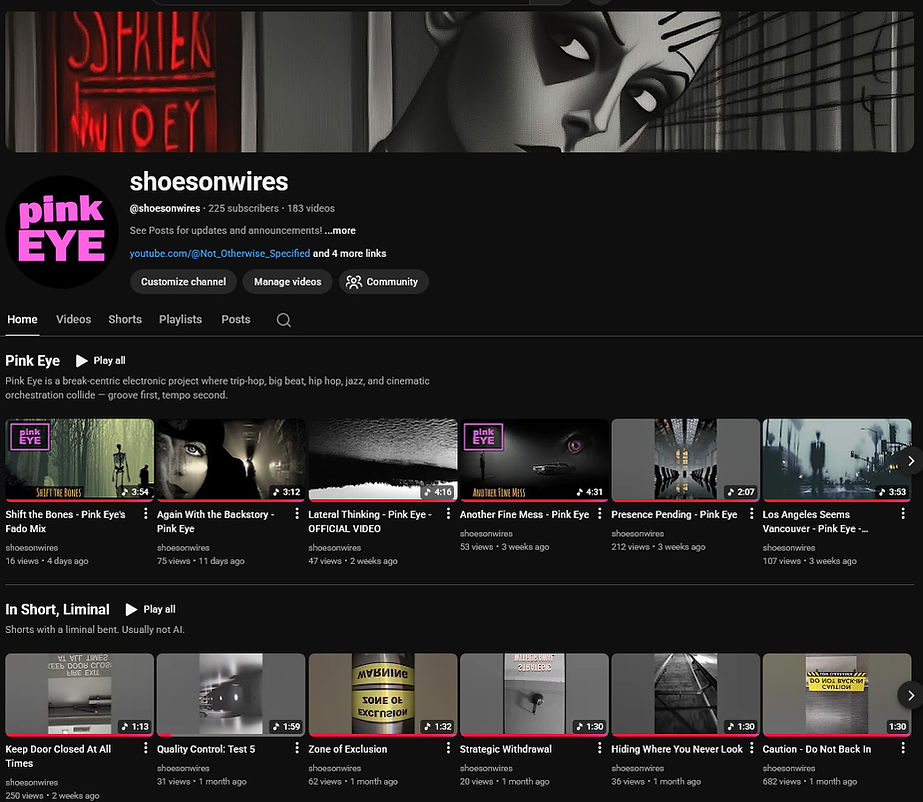
Shell Game was also, for this writer, a direct provocation. Listening to Ratliff navigate a company of entities that could speak but not quite think, that could remember but not quite understand, produced a specific creative pressure; the result is the music suite that accompanies this essay.
https://thehumanityarchive.substack.com/p/this-is-what-it-looks-like-when-reality
https://thereader.mitpress.mit.edu/backrooms-and-the-rise-of-the-institutional-gothic/
https://www.cnn.com/2024/05/06/tech/ai-communicating-with-dead