Aftersound, Liminal Space, and Carrying a Corridor With You

There are experiences that feel meaningful not because they are dramatic, but because they quietly violate assumptions you didn’t realize you were making. This was one of those.
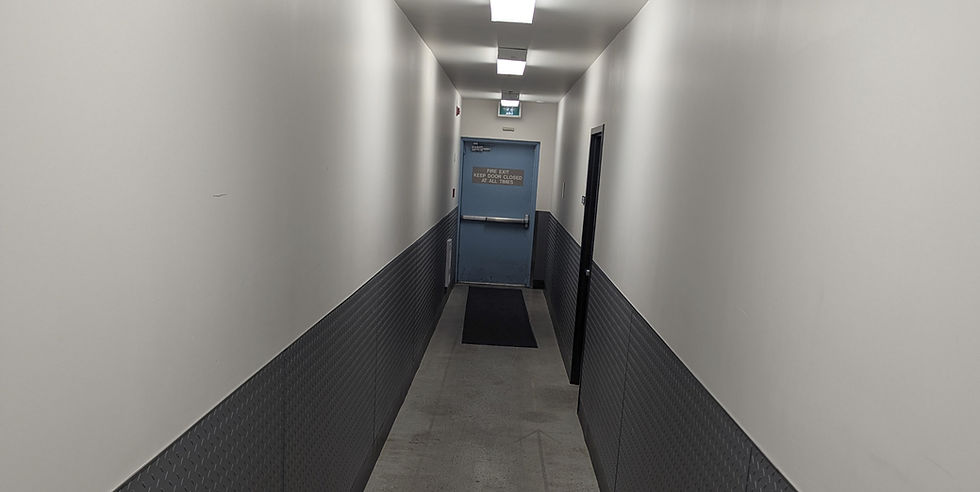
The setting was not a concert hall or studio, but the service corridors of a corporate headquarters - spaces designed to be invisible. These halls exist to connect other places while never becoming destinations themselves. They are utilitarian, transitional, and psychologically erased. You pass through them without forming memories. They are infrastructure, not environment.

I played a proposed Pink Eye track at a loud volume on a small but powerful bluetooth speaker there and recorded it on my phone as I slowly walked through the halls "backstage." Not as a performance, not for an audience, but as an insertion: sound placed into a space that was never meant to host it. That alone carries a certain liminal charge. I was also curious as to how the phone's recording ability would capture the complex reverb that the environment's hard-surfaced intersecting corridors produced as I drifted around. But the central event came later, during playback.
Standing in the same corridor with the speaker now off, listening via earbuds to the recording made there, something unexpected happened: it became impossible to tell whether the sound was coming from the headphones or from the space itself. The acoustic fingerprint of the corridor - its reflections, constraints, and resonant character - aligned so closely with the recording that source attribution collapsed. The sound felt environmental, not internal.
This ambiguity persisted long enough to feel stable. I began to second guess myself. Had I turned the speaker off? Then, as a test, I pulled both earbuds out at once.
The sound stopped abruptly.
Not faded. Not spatially relocated. Simply gone.
The result was a brief but unmistakable disorientation - mild vertigo, a sense of perceptual wrongness, of something left out. Not because of silence itself, but because something that felt continuous had been cut without transition. My nervous system had been straining to locate the source of the sound, and its sudden absence registered like an error - the work continued even though there was no data to process. Like questing fingers feeling along a wall in the dark suddenly encountering a void. Or like walking into a steady headwind that abruptly disappears.
That moment—more than the playing, more than the recording - is the core of the experience.
Aftersound: not echo, not memory
What persisted in that instant after the sound stopped was not reverb or resonance. It was not imagination, either. It was the persistence of expectation - a spatialized auditory presence that outlived its stimulus. If visual afterimages are what remain after light is removed, this was their auditory analogue.
“Aftersound” is not a standard term in psychoacoustics, but the phenomenon itself is well supported by research. Auditory afterimages, residual tones such as the Zwicker tone, and other auditory aftereffects demonstrate that the brain continues processing and perceiving sound after physical input has ceased. In controlled conditions, listeners routinely report tones, textures, or spatial impressions that exist only as neural residue.
What makes this experience distinct is that it occurred in situ, embedded in real architecture and real movement. The auditory system did not merely persist; it persisted in space.
The sound had briefly detached from its source, then from its medium, and existed as a ghosted environmental condition. When it vanished, perception lagged behind reality. That lag - the gap between stimulus cessation and perceptual resolution - is where aftersound lives.
Aftersound and the Opponent Process
One way to understand this phenomenon is through the lens of the Opponent Process, a well-established concept in psychology. The basic idea is that strong or sustained perceptual and emotional states provoke counter-states. In vision, this is why staring at a bright color produces a complementary afterimage when the stimulus is removed. In emotion, it helps explain tolerance, withdrawal, and the way intense experiences are often followed by their opposites.
Aftersound can be understood as the auditory expression of this same process. When sound strongly occupies a space and perception adapts to it, silence is not immediately neutral. It is experienced as an active condition, defined in relation to what preceded it. The nervous system has recalibrated around the stimulus, and when that stimulus disappears, perception briefly overshoots before settling.
What matters here is not the sound itself, but the imbalance created by its removal. The corridor did not simply become quiet; it became wrong for a moment. The opponent process had been engaged, and perception needed time to unwind. Aftersound lives in that unwind - not as memory, but as a compensatory response still catching up to the present.
Liminality as simultaneous occupancy
Liminality is often described as being “between” states: between spaces, roles, or meanings. But the strongest liminal experiences are not transitions. They are overlaps.
After I put the earbuds back in and continued listening to the recording, I walked out of the narrow service corridor into the large, public-facing lobby of the building. Visually, the space opened up. Psychologically, it reasserted itself as corporate, presentable, official.

But the corridor came along.

The acoustic identity of the service hall persisted while my body occupied a different physical environment. The result was a sensation of standing in two places at once. Not metaphorically - perceptually. One space had not erased the other.
This is liminality at full strength: not threshold-crossing, but dual habitation. The hidden infrastructure remained audible inside the visible architecture. The building’s concealed logic refused to stay concealed.
Illbient and infrastructural unease
This experience aligns closely with the ethos of illbient, a loose musical current that emerged in 1990s New York from the experimental margins of hip hop, dub, ambient, and industrial music. Illbient is not ambient music designed to soothe. It is ambient music infected - by urban pressure, by paranoia, by systems that feel morally compromised or psychologically oppressive.
Illbient’s spaces are not forests or starscapes. They are basements, subways, service corridors, surveillance rooms. Its sound does not decorate these environments; it reveals what is wrong with them.
What happened in the corridor was not an illbient composition, but it was an illbient scenario. Sound entered an infrastructural space, fused with it, and then refused to behave properly. The experience did not produce comfort or transcendence. It produced unease, disorientation, and residue.
That residue is the point.
Pink Eye and portable space
Pink Eye, as an ongoing musical and visual project, is deeply concerned with perception, delay, and environments that do not resolve cleanly. Its core is not genre but break logic - rhythmic structures that carry threat, weight, and anticipation rather than release. Its imagery draws heavily on noir and liminal architecture: fog, distance, thresholds, and empty infrastructure.
The corridor experience functions as an origin story for that sensibility, a lived experience that distills the project's canon.
Pink Eye does not simply depict liminal space as one of its central goals/styles. It tries to make it portable. Tracks are often constructed in an attempt to make mood and meaning persist after playback stops, or follow the listener into other contexts. Visuals are not illustrative but compressive, designed to hold multiple readings without collapsing into clarity. Ambiguity is embraced, drift and disorientation are not to be fixed but explored.
The moment of carrying the corridor into the lobby is a literal prototype of that goal. Sound became a gravity well - an organizing force that reshaped perception even when its source was gone. That is exactly what Pink Eye aims to do at the level of track, image, and system.

A brief research context
Scientific research does not yet offer a unified theory of “aftersound,” but several established areas converge on the phenomenon:
Auditory afterimages show that neural activity corresponding to sound can persist after stimulus offset.
The Zwicker tone demonstrates how the auditory system can generate phantom sounds based on prior spectral input.
Gestalt psychology explains how perception prioritizes continuity and coherence, sometimes over accuracy.
Psychoacoustics broadly studies how expectation, memory, and context shape auditory experience.
In music theory and composition, some writers and composers have explicitly explored aftersound as a perceptual and aesthetic phenomenon, treating it as material rather than byproduct.
What is largely missing from the research is attention to situated, real-world experiences where architecture, movement, memory, and playback interact. The corridor event sits precisely in that gap - where laboratory findings meet lived perception.
Why this matters
This was not a performance. It was not documentation. It was not content. It was an experiment in attention that revealed something fundamental about how sound inhabits space and how perception lags behind reality.
The most important insight is simple: sound does not end when it stops playing. It ends when perception catches up.
By then, space may already have changed you.
That is territory that Pink Eye operates in. Not the moment of impact, but the residue. Not the sound itself, but what follows you when it’s gone.
-----
And now the fun part: DIY Perceptual Liminal Experience*
*Results may vary. Consult your physician if the dislocation spreads throughout your life and turns you into some Lovecraftian character.

MATERIALS - What you will need
A space in which to orchestrate the experience
A speaker capable of playing loud, full sound
Headphones/earbuds
An audio/video recording device
A piece of recorded music
At least one functional ear
MATERIALS - In more detail
A Space - You want a space that is:
Private - This experience will take at least 10 - 15 minutes, and you don't want to be disturbed during that time.
Acoustically interesting - Pick somewhere fairly large and composed of hard surfaces, especially shiny surfaces. The goal here is reverb, because a space with reverb has a particular acoustic signature that is different from every other space.
(Ideally) Immediately adjacent to another space with an entirely different acoustic signature. This is a little harder to satisfy, but even having a space like a closet at hand with no reverb at all would probably work. This is for Part Three of the experience. Parts One and Two are still very viable without meeting this physical arrangement.
A Speaker - Any common bluetooth enabled speaker that has a decent sound will do. The important thing is that you are able to make an audio recording and then immediately play that recording through the speaker at some considerable volume, which is why bluetooth is handy, but you could do it with cords and cables.
Headphones - I used earbuds and you probably should, too, for full, 100% occupation of your auditory field; you want to hear only the recording and nothing else. Over-the-ear headphones will probably work quite well, but I haven't put them to the test.
A Recording Device - Realistically, we're talking about a half-decent phone with a half-decent video recording (and associated audio recording) capability. I used a Pixel 7. It also needs the ability to transmit the recording to the speaker, so again we are talking bluetooth.
Music - There is likely a lot of latitude here. I used music with great contrasts between softer/gentle and louder/abrasive, but I think any piece of music that is relatively dense would work, ie, don't choose a minimalist piano solo. Pick a tune that you like, one that lasts at least four minutes or so.
An Ear - One (or two - two is better) that works well and is attached to an open mind.
METHOD - A step-by-step procedure
Standard Caution: If at any point you start to feel uncomfortable or out of your safety zone, simply stop the process. Turn off the music, pack up, and walk away.
Part One is designed to blur the distinction between sound as something “in the world” and sound as something “in your head.”
Part Two involves concluding the conditions that created an aftersound for me.
Part Three provides further dislocation by carrying the acoustic signature of one space into another space.
Part One: Bring the materials to the space and secure the space. You have privacy? Good.
Queue up your track of choice, and play it through the speaker. Play it loud.
Listen to the track for a couple of minutes at least, ideally the whole track. Really let the sound, as it bounces around the environment, soak into you. Walk around a bit as you listen, and notice if the reverb sounds different in different parts of the space. Attend.
Start the track again, and start recording on your device, ie, begin videotaping on your phone. Again, wander around a bit while really absorbing the sound as it fills the space. Record at least a few minutes of the track playing in the space.
Immediately, insert your earbuds or put on your headphones and play the recording. Try to match the volume levels so that the music is as subjectively loud in your ears as it was in the space. Listen for at least a couple of minutes while looking around at the space. It's at this point that I became confused about where the music was coming from. What's your experience like at this point? Can you feel the headphones? Is it like they are not there? Is the music internal and external at the same time? Does the location/source of the sound flip back and forth - internal/external/internal/etc? Is it a blend of both?
Part Two: While you are puzzling over the source of the music, quickly remove the headphones or pull out the earbuds simultaneously. How do you feel? What do you hear? What is the mix of sensation, perception, and expectation? Do you feel vertigo? Disorientation? A feeling of pressure suddenly removed? Is there a feeling like there is now a sound-shaped hole in the air? Like the pressure is lower inside that hole? That it has a pull? Is there a sense that sound is being defined by what it is not? That the absence of the sound has edges? This concludes Part Two, and with any luck you should experienced the Aftersound.
Part Three: Put the headphones back on or earbuds back in. Restart the playback of the recording and listen to it for a minute, refreshing the feeling of hearing sound that could be interior or exterior.
Once you have stabilized and gotten used to the music playing in your ears, walk out of the space and into the adjoining space with a different acoustic signature.
Stop. Listen. Look around. How do you feel? Does it feel like you are in two different places at the same time? Does it feel like you somehow brought the first space with you?
Remove the headphones/earbuds. Normality reasserts itself. The suspended threads of perceptual ambiguity collapse. This concludes Part Three.
-----
Experiences like this are easy to dismiss as tricks of perception, and in a narrow sense that is exactly what they are. But tricks matter. They reveal the assumptions perception relies on to function smoothly, and they show how quickly those assumptions can be unsettled. What the corridor offered was not a revelation about sound itself, but about how much of reality is held together by expectation, by continuity we rarely notice until it breaks. Aftersound is not an exotic anomaly; it is a glimpse into the ordinary lag between the world and our understanding of it.
This is why the experience continues to matter to me, and why it sits so comfortably at the core of Pink Eye. The project is not about making disorientation for its own sake, but about staying with that lag - listening to what persists after the stimulus ends, after the space changes, after certainty collapses. If there is a lesson here, it is not that perception is unreliable, but that it is active, provisional, and deeply shaped by context. Sound ends later than we think. Spaces follow us longer than we expect. And sometimes, if we pay attention, what lingers tells us more than what arrives cleanly and on time.


